Posture pandemic: the daily habits that are wrecking your health
Bad posture affects your balance, mobility and breathing, not just your back and neck. We've got expert advice on how to make a difference.

Bad posture affects your balance, mobility and breathing, not just your back and neck. We've got expert advice on how to make a difference.
It’s easy to think that posture problems are just part of getting older. A little stooping here, a rounded back there, perhaps the feeling that you are not standing quite as tall as you once did. Add in hours spent reading, driving, scrolling, watching television or working at a laptop, and many of us assume it is simply the shape later life takes.
But according to osteopath David Leach, that’s far too resigned a view.
Leach, director of the Luton Osteopathic and Sports Injury Clinic, believes we are living through what he calls a “posture pandemic”, with modern habits gradually reshaping our bodies.
“People think health is about diet and exercise, but what they do for the other 23 hours of the day is what’s really changing their bodies,” he says.
“Health doesn’t start in the gym. It starts with how you sit, stand, scroll and live, every single day.”
Many people worry that getting more hunched, rounded or stooped is just something that happens with time, but Leach’s view is that habits play a far bigger role than many of us think.
“It’s quite easy to change,” he says. “It’s inevitable if you don’t do anything about it –it’s almost a guarantee – but you can actually reverse it by really simple 30-second bursts here and there.”
That’s a much more appealing prospect than punishing workouts or trying to force yourself to “sit up straight” all day, which Leach says rather misses the point anyway.
“The biggest myth is that posture is about sitting up straight,” he says. “The real problem is staying still. Even perfect posture becomes harmful if you don’t move.”
In other words, the issue is less about finding one ideal position and more about not getting stuck in the same one for hours.

Leach says the body adapts to whatever we ask of it most often and for many of us that means head down, shoulders rounded, chest collapsed, eyes fixed on a screen.
“The average person now, if you think about it, stares down for six to eight hours a day minimum… It’s the hours spent stuck,” he says.
That is why posture problems are no longer only about office desks or younger people glued to their phones. They can affect anyone who spends long stretches of the day reading, driving, using a tablet, watching television or sitting in the same position for too long.
“You should fidget, you should alternate – you’re not really designed to be static, unless you lie down,” he says.
These things are not bad in themselves but the body is designed for movement, not hours of stillness.
Poor posture is often talked about as if it is mainly cosmetic – the rounded shoulders, a jutting neck or a less upright stance – but Leach says it can have a knock-on effect on much more than appearance.
“If you’re slumped, you can’t breathe properly,” he says. “Good breathing naturally improves your posture without forcing it.”
He also says posture can affect swallowing, sinus problems and digestion.
"Swallowing issues, sinus problems, ear problems, breathing problems because your upper ribs get compressed, digestive system problems – the list goes on," he says.
That helps explain why poor posture can leave people feeling not just stiff, but tired, uncomfortable and generally not quite themselves.

One of Leach’s most interesting points is that posture is not only about the neck and shoulders, but it can also actually start much lower down.
“When you’re looking at people in their 60s, 70s plus, most people have poor balance,” he says. “It starts from the feet upwards, not their shoulders.”
We tend to think of stooping as an upper-body problem, but poor balance can also feed into the habit of leaning forwards and losing confidence in movement. Leach often asks clients to stand on one foot and count to 10. If they can’t do it without wobbling, they may start leaning forwards and looking down to feel steadier.
His tip is reassuringly simple: practise balancing while waiting for the kettle to boil, keeping your hands close to the worktop for support.
“It becomes a game,” he says.
Leach is a fan of practical fixes rather than big, intimidating exercise plans. He also stresses the importance of not waiting until discomfort turns into something more serious. As he puts it: “Pain comes late. If you feel stiffness or tension, act early. It’s much easier to fix before it becomes a problem.”
One easy fix is simply changing the way you look at your phone or tablet.
“Don’t drop your head to your phone, bring it up to you,” he says. “It’s a simple habit that can save your neck long-term.”
Another is to look up more often during the day. Even 10 to 20 seconds of stretching the front of the throat can help counter hours spent looking down.
“Those hours of looking down are reversed,” he says.
He is also keen on what he calls “microscopic stretches” – brief movements done often. Reaching your arms overhead, changing position regularly, perching rather than sinking into a chair and using reminders near your screen to get up and move can all help.
“You want maximum output from minimum effort,” he says.

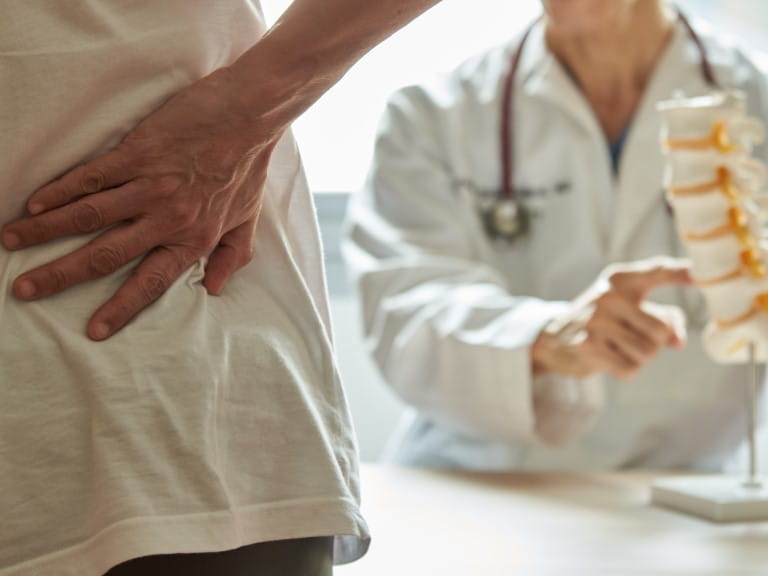
(Hero image credit: GettyImages)



Start a new Saga Health Insurance policy by the end of 28 May 2026 and you’ll get a free £250 M&S gift card. T&Cs apply.
Underwritten by Bupa Insurance Limited.

Some Saga holidays include soothing or spiritual activities like joining a traditional tea ceremony in Japan, practising yoga in India or bathing in Iceland’s Blue Lagoon.

Are you retiring at the wrong age? The best age to retire for your body, brain, happiness and pocket.


Everything you need to know about the lung infection, and how you could be ill with “walking” pneumonia without realising it.

Strong calves for a strong mind: how they support our circulation and brain health, with easy moves to strengthen yours at home.


Our GP Dr Mark Porter explains what can cause itchy skin, which is a common problem as we get older.

Worried you’ve morphed into Victor Meldrew? Find out how to battle that bad mood, and what to do if you’re stuck with a grouchy loved one.

The benefits of heat and cold therapy, and how Nordic bathing won over our nervous writer.

Here’s how to spot the symptoms of heat disease and reduce your danger.


The NHS winter vaccination campaign kicks off next week. Here’s the lowdown on what you need to book.
Pilates for back pain – what to do if you are suffering, and five gentle exercises that could help.

Dizziness or vertigo: a sensation of spinning, can stop us doing everyday things for fear of falling. Try these tips to stop feeling dizzy


You don’t have to put up with bladder leaks. We try out the latest pelvic floor gadgets for men and women.

Cataracts are a normal part of ageing. Learn how to spot the signs – and when it’s time to consider surgery.