Why slippers damage your feet – and what to wear around the house instead
Traditional soft slippers might be comfy but aren’t great for ageing feet. Experts reveal the indoor footwear we should wear instead.
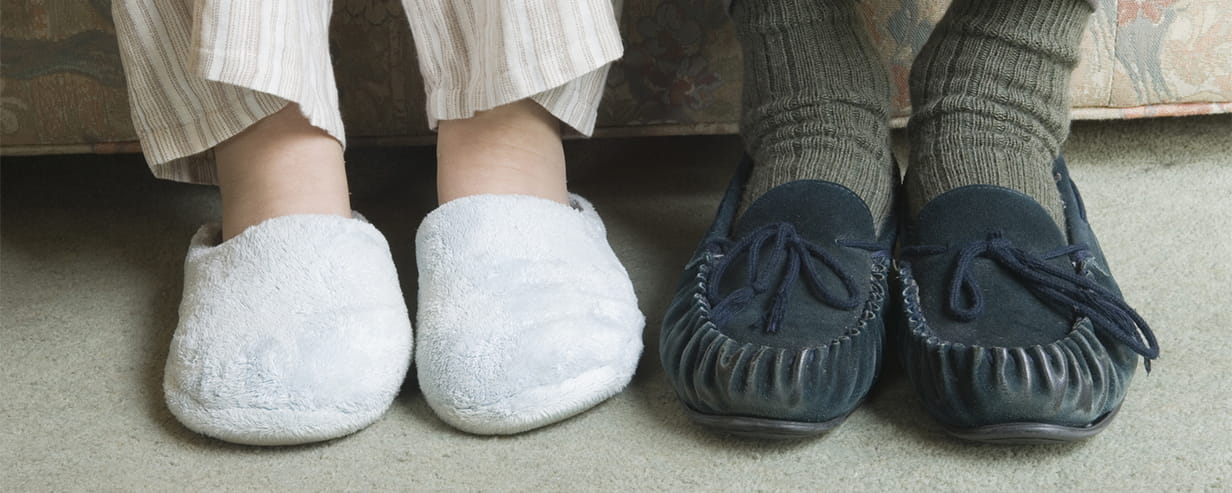
Wearing slippers is a comforting daily ritual that many of us associate with relaxing at home, keeping our feet toasty, and the carpets clean. There’s nothing wrong with that, you may think.
But what about if we’re wearing them all day, from the moment we get up until the moment we get ready for bed?
That’s not unusual for many of us these days. It’s a possible legacy of the pandemic when we spent much more time inside our homes than usual and sales of slippers soared by 46% to £36.8 million.
Although sales have since dropped a bit, slippers remain incredibly popular, whether we’re retired and want to be comfy around the house or are working from home rather than commuting to an office.
“The clue is in the name: SLIP-pers,” says Matthew Fitzpatrick, consultant podiatrist with Foot Factor, a private podiatry and orthotics clinic in London, who highlights the fall dangers of loose-fitting footwear. “Despite their cosy image, slippers are not always benign, particularly if they are showing signs of wear and tear.
“We perhaps don’t put as much thought into choosing a pair of slippers as we do a pair of outdoor shoes, but ironically we sometimes spend more time wearing them.”
A 2020 study found that 67% of older adults reported wearing slippers at home, 72% had worn ill-fitting footwear on both feet and 90% had smooth, partly worn or fully worn soles.
You might think you’re too young or steady on your feet to worry about having a fall yet – but one in three people aged 65 and above will have a fall every year – many of them in good health. This increases to half of all people aged over 80. Many of these falls will happen in their own home.
This is partly due to loss of muscle mass – between the age of 50 and 70 we lose 30% of our muscle strength, bad news if you are trying to balance yourselves after tripping or slipping, says Emmeline Maidment-Fullard, a senior specialist physiotherapist in Manchester, and spokesperson for the Chartered Society of Physiotherapy.
If you can fold your slipper in two, it isn’t supporting your foot. That might not be a problem if you’re sitting on the sofa watching TV. But if you’re wearing them all day, while you do chores and walk about, that’s where the trouble can start.
Walking around, especially on hard floors, requires hard work from the stabilising muscles in the lower legs. And without the support of shoes, there’s nothing to absorb the impact from each step, which will straight go to your knees, hips and lower back.
There’s no arch support in a traditional slipper either, which means your ankle may roll inward if you are inclined towards flat feet. And there’s also nothing to keep your heel in proper alignment.
Those with conditions such as arthritis, sciatica, knee and back pain and plantar fasciitis will likely suffer the most.
“It’s about understanding what you’re doing in the house,” explains Fitzpatrick. “If you are being active doing housework and other chores or standing up cooking for long periods you might want to wear more of an indoor shoe to give your more feet more support. But if you are relaxing on the sofa a softer slipper may be appropriate.
"I encourage my clients to change their footwear throughout the day according to what they are doing.”
A 2019 study found that most older adults wore unprotective footwear indoors, including slippers (21%), flip flops (15%) and backless slippers (7%); 30 % were barefoot; and 3% wore socks. Only one in nine wore protective footwear.
Soles with holes, or flaps, no grips or heel supports, worn down backs, frayed uppers and flimsy flip flops and ill-fitting open back mules can all contribute to falls, as well as contributing to symptoms of painful foot conditions such as plantar fasciitis and arthritis, says Fitzpatrick.
Maidment-Fullard says it’s also important to make sure your slippers still fit as shoe sizes can change as you get older if your arches fall and your feet get wider. “It’s not unusual for your feet to get bigger and go up a shoe size,” she says.
“Around 60% of people wear ill-fitting slippers, and 23% will have a fall within a year.
“People will also wear backless mule type slippers as they’ve always done without giving it much thought, but actually having a bit more support around the foot and ankles can be really helpful.
“I’d say definitely avoid any slippers with a heel height of over an inch as this changes your whole biomechanics, alters the way you walk and can throw you off balance. The same goes for flip flops and sliders as they can come off easily when going down steps and cause falls.
Mules aren’t great for long periods. “A lot of people have mules that are slightly too small and their heel hangs over the back,” Maidment-Fullard says. “Your muscles and feet have to work very hard to keep them on and this can cause muscle strain injuries and lead to you turning over your foot.”
She recommends changing your slippers regularly before they show signs of wear and tear, adding that some local health authorities and councils even offer slipper exchanges where you can get a new pair for free if you hand over your old ones.
Our experts advise to look for the following three features.
“This can be a Velcro strip or any type of fastening that stops them becoming loose and slopping around, increasing the risk of a fall,” says Fitzpatrick.
“This offers more control and helps you keep the slipper or indoor shoe on your feet, avoiding you clawing your toes to keep the slipper or shoe on," says Fitzpatrick. "This helps stop over-straining the long tendons that run along the bottom of the foot.
"If you are constantly clawing your foot to keep your slipper on then these tendons never get relaxed and leads to the tops of your toes becoming more prominent and curling up a bit so you get blisters. Ultimately, walking in this way is not best for your foot function.”
“You need to have some element of shock absorption in your slipper or shoe, when walking on hard indoor surfaces such as tiled, concrete floors, laminate floors and even worn carpets after a while, as there is no spring in those surfaces and this can put stress through the joints in your feet.
"A rubbery grip on the sole will help you avoid slipping on hard surfaces.”
“If you need more ach support you could always insert an orthotic or insole into your slipper to give you more support,” advises Fitzpatrick.
“You can buy these off the shelf – there’s one called the Salford insole which I recommend developed by the University of Salford. The blue one is firmer and the orange one a bit softer, but both are designed for arch problems and the green ones for problems on the outside of the foot. I’ve had patients wear them for decades – they give good support and don’t take up too much room in the slipper or shoes.”
Insoles can also help prevent you straining the plantar fascia ligament, a thick rubber band of connective tissue connecting the heel bone to the base of the toes and avoid you developing painful plantar fasciitis, where the ligament becomes stretched and irritated, developing localised swelling, inflammation, and stabbing pains in the heel and arch area.
“If you’ve tried off the shelf orthotics and they haven’t helped, a podiatrist can undertake further assessments to make you bespoke ones to fit your foot more precisely,” says Fitzpatrick.
“My answer to that is if you have a pair of outdoor shoes or trainers that support you and are comfortable, why not just have another identical pair that you just wear indoors,” says Fitzpatrick.
“My mother does this – she just has the same pair in a different colour to remind her which are for indoors and outdoors.
“If you’re sitting down watching TV you probably don’t need anything as supportive as a trainer, but if you’re doing lots of standing then you may need that extra support. Trainers are good because they are cushioned and have fastenings.
“Croc-style shoes (I’m a big fan) and some of the orthopaedic style clogs you can get may also be a good option, depending on what you are doing in the house and your individual needs.”
“If you’re barefoot your feet can get cold and your skin may dry out and crack more regularly, making you more vulnerable to cuts and scrapes, which can be a problem for people with diabetes, says Fitzpatrick. “Your feet won’t be well supported either which could put them under more strain.
“I definitely wouldn’t recommend just wearing socks as these are a slipping hazard. Hospitals provide slipper socks with grips on the bottom for inpatient stays, but they’re not a good solution for long-term use at home.”
Each of your feet has 26 bones and 33 small joints connected by soft tissue, made up of muscles, tendons, and ligaments, nerves, and blood vessels.
Maidment-Fullard says specific exercises can strengthen the foot and ankle muscles. “You can fit these exercises into your daily routine – for example, practise transferring weight from one foot to the other while you wait for the kettle to boil, supporting yourself by holding onto the kitchen counter,” she suggests. “This will help with maintaining balance, general muscle strength, and circulation.
“You could also do some of the exercises you’d do on a long-haul flight such as ankle circles and stretching your toes out.”
If you are worried about falls, she recommends this leaflet, produced in association with Saga.
The charity Arthritis UK recommends the following foot exercises:
More foot exercises from Arthritis UK, along with a video.
Jo Waters is an award-winning health and medical journalist who writes for national newspapers, consumer magazines and medical websites.
She is the author of four health books, including What's Up with Your Gut? and is a former chair of the Guild of Health Writers.
Health insurance for people over 50 that provides a quicker route to diagnosis and planned medical treatment in a private facility.
Underwritten by Bupa Insurance Limited.
Click below for your chance to win a 15-night cruise to the Canary Islands on board Saga's Spirit of Adventure, worth more than £8,300.
Are you retiring at the wrong age? The best age to retire for your body, brain, happiness and pocket.
Everything you need to know about the lung infection, and how you could be ill with “walking” pneumonia without realising it.
Strong calves for a strong mind: how they support our circulation and brain health, with easy moves to strengthen yours at home.
Our GP Dr Mark Porter explains what can cause itchy skin, which is a common problem as we get older.
Worried you’ve morphed into Victor Meldrew? Find out how to battle that bad mood, and what to do if you’re stuck with a grouchy loved one.
The benefits of heat and cold therapy, and how Nordic bathing won over our nervous writer.
Here’s how to spot the symptoms of heat disease and reduce your danger.
The NHS winter vaccination campaign kicks off next week. Here’s the lowdown on what you need to book.
Pilates for back pain – what to do if you are suffering, and five gentle exercises that could help.
Dizziness or vertigo: a sensation of spinning, can stop us doing everyday things for fear of falling. Try these tips to stop feeling dizzy
You don’t have to put up with bladder leaks. We try out the latest pelvic floor gadgets for men and women.
Cataracts are a normal part of ageing. Learn how to spot the signs – and when it’s time to consider surgery.